
At 2:14 in the morning, the numbers on the monitor changed so quickly that no one in the room had time to pretend everything was going to be all right.
The blood pressure reading fell.
The heart rate climbed beyond 160 beats per minute.
The oxygen level slipped into the low eighties.
Within seconds, the quiet hospital room filled with movement.
Nurses rushed toward the bed. A respiratory therapist adjusted the equipment supporting fifteen-year-old Ethan Walker’s breathing. The overnight physician entered with two members of the critical care team, speaking in short, controlled sentences as they reviewed the monitor and examined the exhausted teenager beneath the blankets.
Ethan’s parents were moved toward the far wall.
They had been through emergencies before. They knew the sound of an alarm, the sudden change in a nurse’s expression, and the terrifying efficiency of a medical team responding to a crisis.
But this felt different.
This time, their son appeared to be drowning inside his own body.
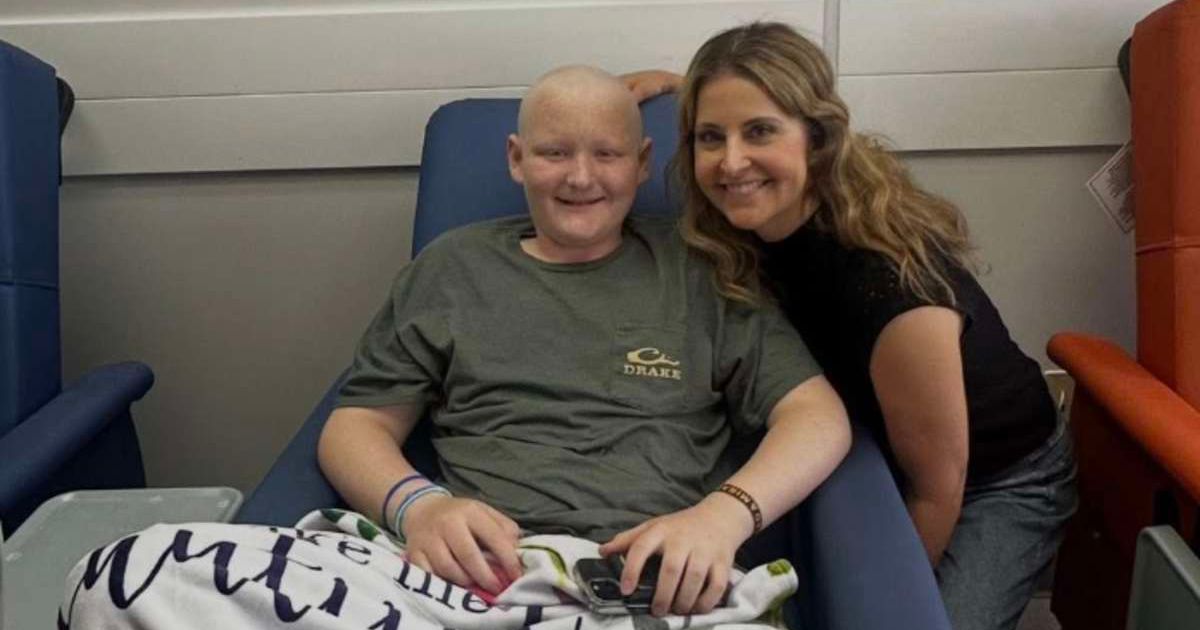
Nearly forty pounds of retained fluid had transformed Ethan’s already fragile condition into a relentless struggle. His face was swollen. His abdomen was painfully distended. His breathing came in shallow, desperate pulls, each one requiring more strength than the last.
His mother stood barefoot on the cold hospital floor, one hand pressed against her mouth.
His father gripped the back of a plastic chair so tightly that his knuckles turned white.
Neither of them spoke.
There was nothing left to say.
The Night Hope Became Almost Impossible
For eighteen months, Ethan had fought an aggressive illness that had gradually taken away nearly every ordinary part of being a teenager.
School hallways had been replaced by hospital corridors.
Weekend plans had become treatment schedules.
Meals were judged not by taste, but by whether he could keep them down.
Family conversations often revolved around blood counts, medications, scans, pain levels, and the next appointment.
Yet Ethan had continued trying to protect the people around him.
He joked with nurses when he had enough energy.
He apologized whenever his parents looked tired.
He asked about his younger sister’s schoolwork even on days when he could barely lift his head.
His body was losing strength, but his instinct to care for others remained untouched.
That was why the early-morning crisis felt especially cruel.
His parents had watched him endure more than they believed any child should have to face. Now they stood only a few feet away, unable to carry even one breath for him.
Forty Pounds of Pressure
Fluid retention can affect the body in devastating ways.
For Ethan, the swelling had developed over days, becoming increasingly difficult to control. What began as puffiness in his hands and feet progressed into widespread pressure that made every movement painful.
His skin felt tight.
His clothing no longer fit comfortably.
Even changing position in bed required help.
Most frightening of all, the excess fluid pressed against the space his lungs needed to expand.
Each breath became smaller.
Each breath came faster.
The oxygen mask covered most of his face, but his parents could still see fear in his eyes.
At one point, he reached weakly toward his mother.
She immediately took his hand.
“I’m here,” she whispered.
Ethan’s fingers barely closed around hers.
“I know,” he mouthed.
The Hours Before Dawn
The medical team worked continuously.
Medications were adjusted.
Laboratory tests were repeated.
Respiratory support was carefully increased.
Every change was measured against Ethan’s ability to tolerate it.
No one offered dramatic assurances.
No one claimed the crisis had passed.
The physician explained that the immediate goal was to stabilize his vital signs and reduce the burden placed on his heart, lungs, and other organs.
His parents listened, nodded, and asked questions they could barely remember afterward.
They had learned that during the worst moments, the mind holds onto fragments.
A doctor’s serious expression.
A nurse squeezing a shoulder.
The time glowing red on the wall.
2:47 a.m.
3:19 a.m.
4:06 a.m.
Every minute felt like an hour.
A Family Praying Without Words
By sunrise, the room was quieter, but not peaceful.
Ethan’s heart rate remained dangerously high.
His oxygen level continued to fluctuate.
His blood pressure required constant attention.
His mother sat beside the bed with her forehead resting against his hand.
She had prayed so many times during the previous year that she no longer knew what words to use.
There had been prayers for healing.
Prayers for strength.
Prayers for good scan results.
Prayers for one night without pain.
That morning, her prayer became simpler.
“Please let him breathe.”
Across the room, Ethan’s father stared through the window at the pale light beginning to spread across the city.
He had always believed it was his responsibility to fix problems.
A broken car.
A leaking roof.
A missed payment.
A difficult day.
But there was no tool he could hold and no repair he could make that would remove the fluid crushing his son’s body.
Helplessness, he later said, was heavier than fear.
The Decision to Drain the Fluid
As the day continued, specialists reviewed Ethan’s condition.
The fluid had become more than a source of discomfort. It was interfering with his ability to breathe and placing dangerous pressure on his already weakened system.
The team discussed a procedure intended to remove enough fluid to provide relief.
It carried risks.
Nearly every decision did.
Ethan’s parents listened carefully as the physicians explained the goals, limitations, and possible complications.
There was no promise that it would solve the larger crisis.
But it might give him room to breathe.
Sometimes, in the most serious battles, one breath is enough reason to act.
They agreed.
Waiting Through Another Endless Afternoon
Preparations took time.
Equipment was brought into the room.
The nursing team reviewed medications and positioning.
The physician explained the procedure again, this time directly to Ethan.
He listened with his eyes closed.
When asked whether he understood, he gave a faint nod.
His mother leaned close.
“We’ll be right here.”
Ethan opened his eyes briefly.
“You always are,” he whispered.
Those four words nearly broke her.
The procedure began while the family waited nearby.
The hospital clock continued moving, indifferent to the fear beneath it.
Outside the room, Ethan’s father paced in a narrow line between two walls.
His mother sat motionless, holding the hooded sweatshirt her son had worn during his last trip home.
Neither knew what the next update would bring.
The Change at 7:38 P.M.
By 7:38 that evening, the first visible change appeared.
The drainage had removed a significant amount of fluid.
The swelling had not disappeared, but the pressure around Ethan’s chest had eased enough for his breathing to become less frantic.
His oxygen level slowly began moving upward.
His heart rate remained elevated, though no longer climbing as violently.
The change was not a miracle.
It was not a recovery.
It was relief.
And after the night they had survived, relief felt enormous.
A nurse adjusted Ethan’s pillows and gently cleaned his face. For the first time in hours, the tight expression around his eyes softened.
His parents stood on either side of the bed.
Neither wanted to speak too loudly.
They were afraid of disturbing the fragile calm that had finally settled over the room.
Then Ethan moved his hand.
His father immediately leaned closer.
“What is it, buddy?”
Ethan swallowed before answering.
His voice was little more than air.
The Promise
“If they get all this fluid off me,” he whispered, “I’ll make myself eat.”
His mother’s eyes filled instantly.
For weeks, food had become another struggle.
Pain, nausea, exhaustion, and swelling had destroyed his appetite. Even a few bites required enormous effort.
Ethan continued.
“I want to get off anything I can.”
His father looked away, trying to regain control of his emotions.
Ethan was not making a grand promise about defeating illness.
He was not claiming that everything would suddenly become easy.
He was promising to try.
To eat.
To regain strength.
To reduce his dependence on machines and medications wherever possible.
To participate in his own fight for as long as his body allowed.
The promise was heartbreaking because of how ordinary it sounded.
Most teenagers never have to promise their parents they will force themselves to eat.
Most families never celebrate a few bites of food as an act of courage.
But inside that hospital room, Ethan’s words became proof that he was still looking toward tomorrow.
Humor in the Middle of Pain
After a few quiet moments, Ethan managed the faintest smile.
“At least you won’t have to worry about me gaining too much weight after this,” he murmured.
His mother laughed and cried at the same time.
His father lowered his head until his forehead touched Ethan’s hand.
Even in severe pain, Ethan was trying to comfort them.
That was who he had always been.
The boy in the bed looked exhausted beyond words, yet he was still searching for a way to make his parents smile.
Not the Miracle They Wanted
The medical team remained honest.
The drainage had provided relief, but Ethan’s condition was still critical.
His organs required close monitoring.
The fluid could return.
His vital signs remained fragile.
There were difficult decisions ahead.
The family understood that one encouraging evening could not erase the danger of the previous night.
Recovery was not guaranteed.
But the absence of a miracle did not mean the absence of hope.
Hope had changed shape.
It was no longer a dramatic cure arriving in the darkness.
It was an oxygen number slowly improving.
A heart rate beginning to settle.
A son whispering that he would try to eat.
A family choosing to stand beside him for one more night.
Fighting Another Day
As midnight approached again, Ethan finally slept.
His breathing remained supported, but it was calmer than it had been twenty-two hours earlier.
His mother stayed beside him, watching every rise and fall of his chest.
His father sat nearby with his arms folded, too exhausted to speak and too frightened to leave.
No one knew what morning would bring.
The family had stopped asking for certainty.
They asked only for time.
Time for Ethan’s body to recover from the pressure.
Time for the doctors to find the next step.
Time for him to keep the promise he had whispered after the swelling began to ease.
There had been no miracle the night before.
There had been terror, pain, alarms, and hours that seemed impossible to survive.
But there had also been skilled hands, a determined medical team, a family that refused to leave, and a fifteen-year-old boy who still believed he might become strong enough to try again.
Sometimes the turning point is not the moment the battle ends.
Sometimes it is the moment, after the darkest night imaginable, when someone opens his eyes and quietly promises to keep fighting.