
For years, South Africa’s Kruger National Park has been presented to the world as the crown jewel of African tourism — a breathtaking wildlife sanctuary where international travelers could safely experience the raw beauty of nature without sacrificing modern security.
Every year, thousands of tourists from the United States and Europe travel across continents to witness lions roaming open plains, elephants crossing dusty roads, and sunsets stretching endlessly across protected wilderness.
But now, the horrifying deaths of retired couple Ernst Marais, 71, and his wife Dina, 73, are forcing global investigators to confront a terrifying possibility:
What if one of Africa’s most famous tourist destinations has been hiding a dangerous border vulnerability for years?
Because according to emerging investigative details, the evidence no longer points toward a random act of violence.
Instead, investigators increasingly fear the couple may have encountered a highly organized cross-border operation functioning deep inside the shadows of Kruger National Park.
And the tactical clues left behind are deeply disturbing.
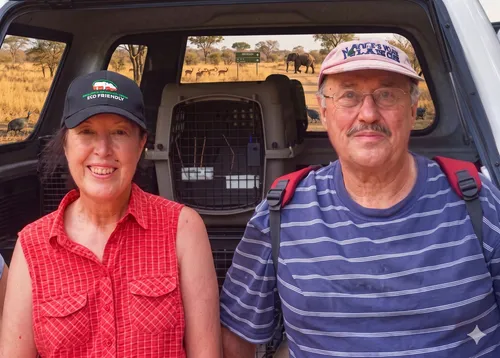
The Dream Vacation That Became a Nightmare
Friends describe Ernst and Dina Marais as kind, experienced travelers who had dreamed about visiting Kruger National Park for years.
Like many retirees, the couple viewed the safari as the reward after a lifetime of work — a final grand adventure surrounded by Africa’s legendary wildlife landscapes.
They reportedly arrived excited and optimistic, driving a Ford Ranger through the northern sectors of the park while following a carefully planned safari route.
Nothing initially appeared unusual.
The couple explored scenic regions popular with international tourists and spent nights inside designated travel areas considered safe for visitors.
Then, without warning, they vanished.
The Campsite That Alarmed Rangers
Concern reportedly began after Ernst and Dina failed to appear at their next expected stop inside the reserve.
At first, park officials suspected routine travel complications.
Safari delays happen regularly inside remote wilderness areas. Wildlife often blocks roads, vehicles can break down, and communication coverage in isolated sectors remains inconsistent.
But when rangers eventually located the couple’s campsite, investigators immediately realized something was terribly wrong.
The tent remained open.
Food still sat untouched on the table.
Travel gear and personal belongings remained inside the camp.
Nothing appeared packed.
Nothing appeared stolen.
To search teams, the entire scene looked frozen in time — as though the couple had suddenly disappeared in the middle of an ordinary evening.
But it was the absence of evidence that frightened investigators most.
No emergency distress signal.
No obvious signs of a prolonged struggle.
No clear explanation for how two elderly tourists could vanish without leaving behind immediate answers.
That was when authorities launched a full-scale search operation across the northern regions of Kruger National Park.
The Horror Waiting at Crooks Corner
Several days later, tourists near a remote river junction known as Crooks Corner reportedly spotted something floating in the water.
Authorities later confirmed the remains belonged to Ernst and Dina Marais.
Officials classified the case as involving foul play.
But as forensic investigators began analyzing the crime scene, the details became even more chilling.
Because the evidence suggested planning.
Precision.
Experience.
And possibly the involvement of organized groups already familiar with cross-border movement through the reserve.

The Knot Signature Investigators Cannot Ignore
One of the most disturbing forensic clues reportedly involves the restraints used on the victims.
According to sources close to the investigation, detectives are now analyzing the exact knot patterns used to bind the couple’s hands.
Why?
Because professional knot techniques can reveal critical information about training and operational background.
Investigators reportedly believe the bindings were not random or improvised.
The knots allegedly displayed characteristics associated with individuals experienced in tactical restraint methods — techniques sometimes linked to smuggling networks, poaching syndicates, or organized border-crossing groups operating throughout southern Africa.
For forensic analysts, knot signatures can function almost like fingerprints.
Different criminal organizations, maritime workers, hunters, and military-trained individuals often use recognizable tying methods developed through years of repetition.
Now investigators are reportedly attempting to determine whether those knot patterns match known criminal operations active near the Mozambique border.
If confirmed, the implications would be enormous.
Because it would suggest the perpetrators were not ordinary opportunistic attackers.
They were experienced.
The Weapon Clues Raising New Fears
Investigators are also reportedly examining wound patterns indicating the use of heavy hunting blades.
According to regional security experts, large fixed-blade knives are frequently carried by illegal border crossers, poachers, and wilderness trafficking groups operating in remote terrain where firearms attract unwanted attention.
Unlike tourists, organized wilderness criminals often rely on silent weapons specifically designed for survival in dense bush environments.
Those weapons are durable, practical, and easy to conceal during cross-border movement.
For investigators, the alleged use of hunting blades further strengthens fears that the perpetrators possessed experience navigating harsh wilderness terrain.
And that possibility is now deeply alarming international security analysts.
Because it suggests criminal networks may be operating far closer to tourist travel routes than authorities previously admitted.
Why Crooks Corner Was a Chosen Location
Perhaps the most chilling detail involves where the couple was ultimately discovered.
Crooks Corner has long carried a dark reputation throughout southern Africa.
Located near the intersection of South Africa, Mozambique, and Zimbabwe, the region has historically been associated with smugglers, fugitives, poachers, and cross-border trafficking routes hidden within difficult wilderness terrain.
Local guides have quietly warned travelers about the area for years.
Some former rangers describe the region as nearly impossible to fully secure due to rivers, thick vegetation, and isolated escape corridors stretching across international boundaries.
But investigators now reportedly believe the location itself may have been intentionally selected.
Why?
Because predator-heavy river systems can rapidly destroy forensic evidence.
Security experts believe abandoning victims in such waters could represent a deliberate tactic aimed at complicating investigations, delaying identification, and eliminating physical evidence before authorities recover remains.
If true, that detail would again point toward experienced perpetrators familiar with both the environment and forensic countermeasures.
The Border Breach That Shocked Investigators
Yet even after the horrifying discovery at Crooks Corner, investigators still had one major unanswered question.
Where was the couple’s vehicle?
Authorities later discovered that Ernst and Dina’s Ford Ranger never officially exited Kruger National Park through any monitored security gate.
There was no recorded departure.
No checkpoint alert.
No electronic exit trace.
Then search teams uncovered something even more disturbing.
Tire tracks reportedly led directly through wild bush terrain toward the Mozambique border.
Those tracks allegedly crushed sections of the international border fence during the escape.
For investigators, that discovery changed the entire nature of the case.
Because whoever drove the vehicle appeared to possess detailed knowledge of the terrain, patrol gaps, and vulnerable border sections.
This was not reckless improvisation.
The route suggested confidence.
Planning.
Experience.
And familiarity with hidden movement corridors inside one of Africa’s most famous wildlife reserves.
The Growing Fear Among International Travelers
The story has now exploded across travel forums throughout the United States and Europe.
For many international tourists, the horror lies not only in the crime itself — but in what it reveals about potential security weaknesses inside protected safari zones.
Kruger National Park has long marketed itself as a carefully monitored tourism environment where visitors can safely explore wilderness under the protection of advanced surveillance systems and ranger operations.
But the Marais case has shaken that image dramatically.
Travelers are now asking difficult questions:
How could perpetrators bypass every high-tech checkpoint?
Were criminal groups already operating inside tourist corridors?
How many remote sectors remain vulnerable to cross-border infiltration?
And perhaps most disturbing of all:
Did authorities already know about these risks?
Local Insiders Are Telling a Different Story
While mainstream reporting has largely framed the case as an isolated tragedy, some local security observers claim the reality may be far more complicated.
Former anti-poaching personnel have repeatedly warned about increasingly sophisticated criminal operations moving through border sectors near Kruger.
Some describe armed groups using advanced communication systems, scouts, and hidden navigation routes to bypass security infrastructure.
Others argue that tourism marketing campaigns often downplay the true scale of cross-border criminal activity to protect the safari industry.
Authorities continue emphasizing that millions of tourists safely visit South Africa every year.
But after the deaths of Ernst and Dina Marais, many travelers are no longer viewing those reassurances the same way.
The Questions Still Haunting Investigators
Tonight, investigators continue reconstructing the couple’s final movements.
The untouched campsite.
The professional restraints.
The hunting blades.
The predator-heavy river.
The crushed international border fence.
Each detail paints the picture of something far more calculated than random violence.
And until authorities fully explain how such an operation unfolded inside one of Africa’s flagship tourist destinations, fear surrounding safari travel will continue spreading worldwide.
Because for Ernst and Dina Marais, the adventure they spent years dreaming about ended not with breathtaking memories of Africa —
but with a terrifying mystery that has exposed what many now fear may be one of the continent’s most dangerous hidden security blind spots.
And for travelers preparing safari vacations tonight, one chilling question remains impossible to ignore:
If organized groups can move this freely through protected tourist zones, who is truly controlling the wilderness after dark?