
BREAKING: The Safari Vacation That Ended in Terror at Crooks Corner
For thousands of American travelers every year, South Africa’s Kruger National Park represents the ultimate dream escape — endless golden savannas, luxury safari lodges, roaring lions beneath blood-red sunsets, and the promise of witnessing nature untouched by civilization.
But for retired couple Ernst Marais, 71, and his wife Dina, 73, that dream became something far darker.
What was supposed to be the final great adventure of their retirement has now spiraled into one of the most disturbing safari mysteries in recent memory — a case involving a vanished campsite, a brutal discovery near one of Africa’s most dangerous border zones, and a stolen vehicle that seemingly disappeared into the wilderness itself.
Now, investigators are trying to answer a chilling question:
Who is really operating in the shadows of Kruger National Park?
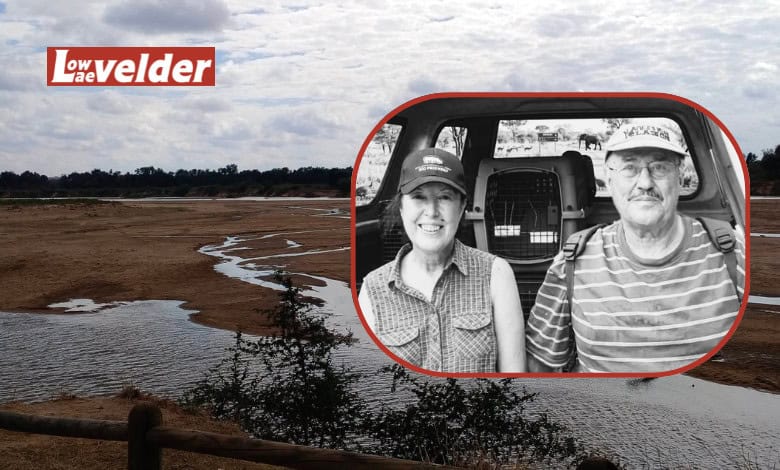
The Couple Who Saved for Years to Reach Africa
Friends described Ernst and Dina Marais as quiet, warm-hearted retirees who had spent decades dreaming about Africa.
The couple reportedly spent years planning their safari journey. Like many Western travelers, they were captivated by photographs of Kruger National Park — sprawling landscapes filled with elephants, rhinos, giraffes, and predators roaming freely across one of the most iconic wildlife reserves on Earth.
To them, the trip symbolized freedom after a lifetime of work.
According to early reports, the couple entered the northern sector of Kruger during what should have been a routine safari itinerary. They traveled in a rented 4×4 vehicle and planned to camp for several nights before continuing deeper into the reserve.
Nothing initially appeared unusual.
Until everything suddenly stopped.
The Campsite Discovery
Park staff first became concerned after the couple failed to check in at a scheduled location.
At first, officials assumed a delay caused by wildlife traffic, vehicle trouble, or poor communication coverage — all common issues inside remote safari zones.
But when rangers eventually reached the campsite, they reportedly encountered a scene that immediately felt wrong.
The tent stood wide open.
Food remained untouched on the table.
Personal belongings were still scattered around the camp.
There were no signs of preparation for departure.
No packed bags.
No indication the couple had voluntarily left the site.
It looked as though life inside the camp had frozen mid-moment.
Then investigators noticed something even more unsettling:
There was no trace of Ernst or Dina anywhere in the surrounding area.
Not a footprint leading into the bush.
Not a distress signal.
Nothing.
Within hours, search teams began sweeping nearby terrain while helicopters scanned the dense northern wilderness from above.
But the deeper authorities searched, the stranger the case became.
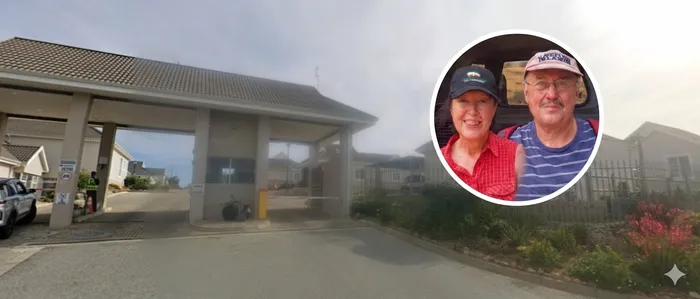
Crooks Corner: The Lawless Border Zone
Days later, tourists reportedly spotted something horrifying floating near a remote river intersection known as “Crooks Corner.”
For decades, Crooks Corner has carried a dark reputation throughout southern Africa.
Located where the borders of South Africa, Mozambique, and Zimbabwe converge, the region has historically been associated with smuggling routes, poaching syndicates, fugitives, and organized criminal networks capable of slipping between jurisdictions almost undetected.
Locals have long warned visitors about the dangers surrounding the isolated border area.
Some safari guides even avoid discussing its history openly with tourists.
But now the location has become the center of an international investigation.
Authorities later confirmed the bodies recovered near the river belonged to Ernst and Dina Marais.
Reports indicated the couple had been tightly restrained before being abandoned in crocodile-infested waters.
Investigators officially classified the case as involving foul play.
And suddenly, what initially appeared to be a missing persons incident transformed into a terrifying cross-border homicide mystery.
The Vehicle That Never Left the Park
Yet the most baffling detail was still waiting to emerge.
After reviewing gate surveillance and ranger checkpoints, investigators reportedly discovered that the couple’s 4×4 vehicle never officially exited Kruger National Park.
There was no recorded departure.
No electronic exit log.
Nothing.
Then rangers discovered tire tracks cutting directly through wild bush terrain toward the Mozambique border.
According to reports, the tracks appeared to bypass formal roads entirely before eventually crushing sections of fencing near the international boundary.
To investigators, the implications were deeply troubling.
Whoever took the vehicle seemed to know the terrain extremely well.
This was not a random opportunistic crime.
The route suggested planning, familiarity with ranger patrol patterns, and confidence operating inside one of Africa’s largest protected wildlife zones.
That realization has intensified fears surrounding criminal syndicates that allegedly exploit the park’s vast wilderness as a hidden transportation corridor.
The Hidden War Inside Kruger
While tourists often view Kruger as a paradise for wildlife photography and luxury safaris, security experts have long warned that parts of the reserve exist under constant pressure from heavily armed poaching networks.
Rhino horn trafficking alone has fueled violent criminal operations throughout southern Africa for years.
Some syndicates reportedly move through remote park sectors using military-style tactics, crossing borders under cover of darkness while avoiding law enforcement patrols.
Former anti-poaching rangers have described firefights deep inside the bush.
Others have spoken about organized groups using sophisticated communication equipment, night-vision technology, and hidden routes unknown to ordinary tourists.
In recent years, authorities have strengthened anti-poaching operations throughout Kruger.
But critics argue that the sheer size of the reserve — combined with porous international borders — creates vulnerabilities impossible to fully control.
Now, following the deaths of Ernst and Dina Marais, those fears are resurfacing with renewed urgency.
Because this time, the victims were not rangers or suspected traffickers.
They were elderly tourists.
Why This Case Is Triggering International Fear
The story has rapidly spread across travel communities online, particularly among Western tourists planning African safaris.
For many readers, the case strikes at the heart of a terrifying possibility:
What happens when organized criminal activity collides with international tourism?
Travel analysts say the psychological impact of the case is enormous because safaris are typically marketed as controlled luxury experiences — carefully monitored environments where visitors feel protected despite the surrounding wilderness.
But the Marais case challenges that perception.
The unanswered questions continue to multiply:
How could attackers move through the park without detection?
How did a stolen vehicle breach an international border fence?
Why were no emergency signals triggered?
And perhaps most disturbingly:
Was the couple specifically targeted, or were they simply in the wrong place at the wrong time?
The Growing Pressure on Authorities
As international attention intensifies, pressure is mounting on regional authorities to explain exactly what happened inside the northern reaches of Kruger National Park.
Officials have publicly urged travelers not to panic, emphasizing that millions of tourists safely visit South Africa every year.
But critics argue that the situation exposes deeper security problems surrounding remote safari routes near unstable border regions.
Security experts say vast wilderness reserves create unique policing challenges unlike ordinary urban crime scenes.
Response times can stretch for hours.
Communications infrastructure is limited.
And dense terrain offers countless escape corridors for organized groups familiar with the environment.
Meanwhile, online speculation has exploded across social media platforms, with some users alleging the existence of underground trafficking corridors operating beneath the cover of wildlife territory.
Authorities have not confirmed those claims.
Still, the mystery surrounding the couple’s final hours continues fueling public anxiety.
The Questions That Refuse to Disappear
Tonight, investigators are still piecing together the couple’s final movements.
Somewhere between an untouched dinner table and the crocodile waters of Crooks Corner, something catastrophic happened.
The evidence suggests precision.
The terrain suggests experience.
And the missing vehicle route suggests knowledge of hidden pathways through one of the world’s most famous wildlife reserves.
For now, many of the answers remain buried inside the vast African bush.
But one reality is already impossible to ignore:
For Ernst and Dina Marais, the safari adventure they spent years dreaming about ended not with photographs of lions beneath the sunset —
but with a mystery that has shaken travelers around the world.
And until authorities fully explain who was moving through the shadows of Kruger National Park that night, the fear surrounding Crooks Corner is unlikely to disappear anytime soon.